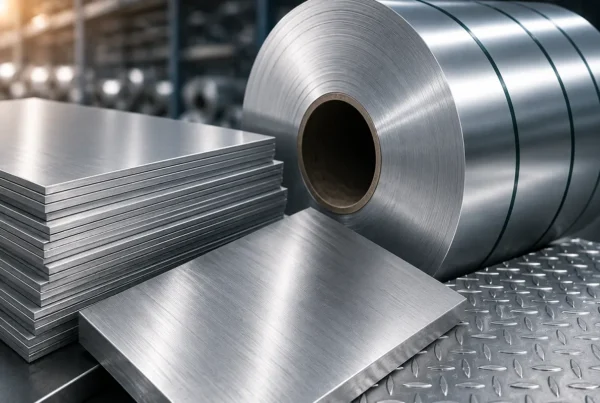
Aluminium is one of the most widely used metals across various industries thanks to its lightweight structure, excellent corrosion resistance, and high durability. Among the different forms available on the market, aluminium coil and aluminium sheet are the two most common products. Although they are manufactured from the same material, they differ significantly in terms of production, processing methods, and intended applications.
So, should you choose aluminium coil or aluminium sheet for your next project? In this guide, we compare both products, highlighting their advantages, applications, and key differences to help you make the right decision.
What Is Aluminium Coil?
Aluminium coil is produced by rolling aluminium into long continuous sheets and winding them into large coils. It is an ideal solution for manufacturers that require high-volume production and continuous processing.
Aluminium coils can be supplied in various widths, thicknesses, and alloy grades. They are commonly processed through slitting or cut-to-length operations before being used in manufacturing.
Typical industries using aluminium coils include:
- Automotive
- HVAC and ventilation systems
- Packaging
- Roofing systems
- White goods manufacturing
- Industrial production
For companies with continuous production lines, aluminium coil provides improved efficiency while reducing material waste.
What Is Aluminium Sheet?
Aluminium sheet consists of flat panels that are cut into standard or custom dimensions and are ready for immediate use. Sheets are available in a wide range of thicknesses, sizes, and alloy grades to meet different project requirements.
Because they are supplied in finished dimensions, aluminium sheets are ideal for fabrication processes such as laser cutting, CNC machining, bending, welding, and drilling.
They are widely used in:
- Industrial machinery
- Construction
- Architectural projects
- Marine applications
- Transportation
- Signage and advertising
- General manufacturing
Aluminium Coil vs Aluminium Sheet: What Are the Differences?
Although both products are made from aluminium, they are designed for different production needs.
Advantages of Aluminium Coil
- Suitable for continuous manufacturing processes
- Cost-effective for high-volume production
- Can be slit or cut to custom lengths
- Requires less storage space in many applications
- Reduces production downtime
- Improves manufacturing efficiency
Advantages of Aluminium Sheet
- Ready-to-use flat panels
- Ideal for custom fabrication
- Compatible with laser cutting and CNC machining
- Easy to bend, weld, and drill
- Available in numerous alloy grades and thicknesses
- Perfect for architectural and industrial projects
When Should You Choose Aluminium Coil?
Aluminium coil is the preferred solution for manufacturers with continuous production processes or companies that process large quantities of aluminium.
Businesses equipped with slitting or cut-to-length machines can process coils into the exact dimensions required for production, minimizing waste and increasing operational efficiency.
Aluminium coils are also advantageous for large-scale projects because they simplify logistics and help reduce material costs over time.
When Is Aluminium Sheet the Better Choice?
If your project requires ready-to-use material in fixed dimensions, aluminium sheet is usually the better option.
Applications involving laser cutting, CNC machining, custom fabrication, architectural cladding, machine components, or signage typically benefit from aluminium sheets because they require minimal preparation before processing.
For low- to medium-volume production and one-off projects, aluminium sheets offer greater flexibility and convenience.
Why Is Choosing the Right Product Important?
Selecting the correct aluminium product is about more than just cost. Factors such as production methods, fabrication processes, project specifications, and material efficiency all influence the best choice.
Using the wrong product can increase manufacturing costs, generate unnecessary waste, and reduce production efficiency.
By selecting the appropriate alloy, thickness, and product form, businesses can improve productivity while optimizing overall project costs.
Conclusion
There is no single answer to the question, “Aluminium coil or aluminium sheet?” The right choice depends entirely on your production process and project requirements.
For continuous manufacturing and large-scale production, aluminium coil offers greater flexibility and cost efficiency. For custom fabrication and ready-to-use applications, aluminium sheet provides superior convenience and ease of processing.
Working with an experienced aluminium supplier ensures that you receive the right material, alloy, and dimensions for your project, helping you achieve long-lasting performance and cost-effective results.
Frequently Asked Questions
What is the difference between aluminium coil and aluminium sheet?
Aluminium coil is supplied in rolled form and can be cut into custom sizes, while aluminium sheet is delivered as flat panels in ready-to-use dimensions.
Which product is more cost-effective?
For high-volume manufacturing, aluminium coil is generally more economical. For smaller projects or custom fabrication, aluminium sheet is often the better choice.
Can aluminium sheet be laser cut?
Yes. Aluminium sheets are widely used for laser cutting, CNC machining, bending, welding, and other fabrication processes.
Can aluminium coil be cut into custom sizes?
Yes. Aluminium coils can be processed through slitting and cut-to-length operations to meet specific project requirements.
Are aluminium coil and aluminium sheet available in the same alloy grades?
Yes. Both products are available in popular aluminium alloys such as 1050, 3003, 5005, 5754, and 5083, depending on the intended application.